

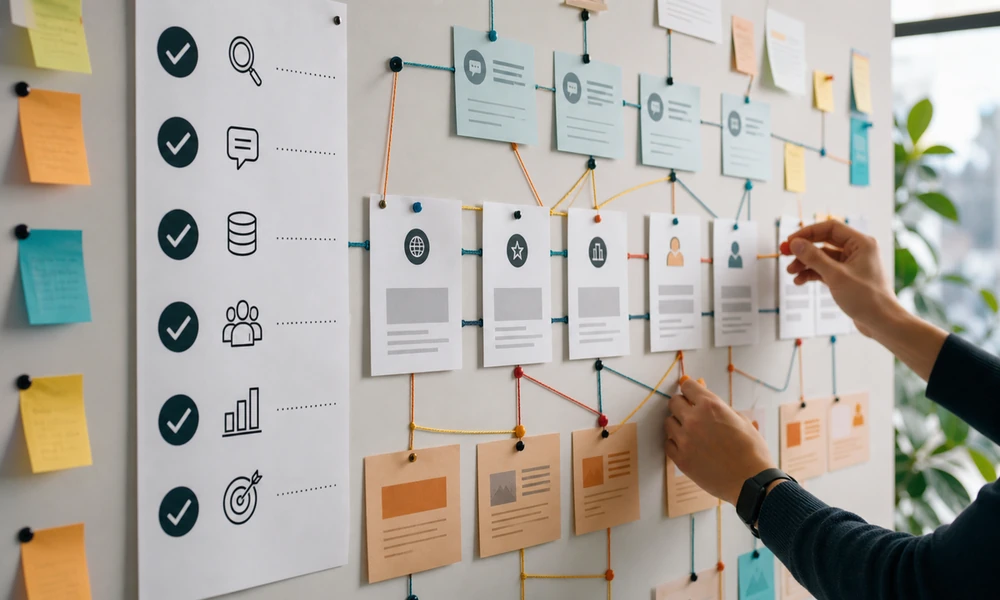
A GEO analytics workflow should help a team make decisions, not simply collect screenshots of AI answers. As more search experiences summarize information through generated responses, marketers need a way to understand how brands are represented inside those answers. The challenge is that AI visibility is multi-dimensional. A brand can be visible for one question and absent for another. It can be described accurately in broad prompts but poorly in detailed comparisons. It can be recommended for one audience and ignored for another. A useful workflow must capture these differences.
The first thing to look for is prompt structure. A workflow should allow teams to organize prompts by topic, intent, persona, and stage of evaluation. Without structure, the team may collect a long list of unrelated questions and struggle to interpret the results. Good prompt structure makes trends visible. It shows whether a brand is stronger in awareness questions or decision questions, whether it appears in competitor comparisons, and whether it is connected to the right use cases.
The second requirement is competitor context. AI answers often explain a category by naming several options together. If a team only looks for its own brand, it misses the relative story. Competitor context shows who appears in the same answer, how they are framed, and which claims are repeated. This can reveal practical content opportunities. For example, if a competitor is repeatedly associated with ease of setup, the team may need clearer implementation proof. If another brand dominates enterprise prompts, the team may need stronger case studies or procurement content.
The third requirement is content traceability. When a result looks weak, the team should be able to ask why. Does the website lack a page that explains the topic? Are existing pages too vague? Are third-party descriptions outdated? Are blog posts covering awareness topics but not evaluation topics? Reading practical GEO examples can help teams think through these patterns before they commit to a reporting process. The best workflow connects answer observations with the content assets that can influence future answers.
The fourth requirement is consistency over time. A one-time check can be useful for discovery, but it is not enough for management. Teams need repeated checks across the same prompt groups so they can see whether content updates are changing answer behavior. This does not mean every prompt needs to be checked every day. It means the team should have a repeatable schedule, stable categories, and a clear way to compare results from one cycle to the next.
Finally, a GEO workflow should encourage editorial judgment. Not every missing mention deserves a new article. Some prompts may be low intent, too broad, or outside the brand’s real market. A good workflow helps teams prioritize the gaps that matter. It should lead to better product pages, clearer comparison pages, stronger educational articles, and more precise messaging. The goal is not to manipulate answer engines. The goal is to make the brand easier to understand when buyers ask serious questions. A workflow that supports that goal will be more valuable than a workflow that only produces a visibility score.
For teams that need a consistent way to compare brand visibility across AI-generated answers, a GEO comparison hub can turn prompt checks, competitor mentions, and content gaps into a repeatable review process.
To keep the process fresh, teams can also follow an AI search visibility blog for practical ideas that connect answer patterns with weekly content decisions.
