

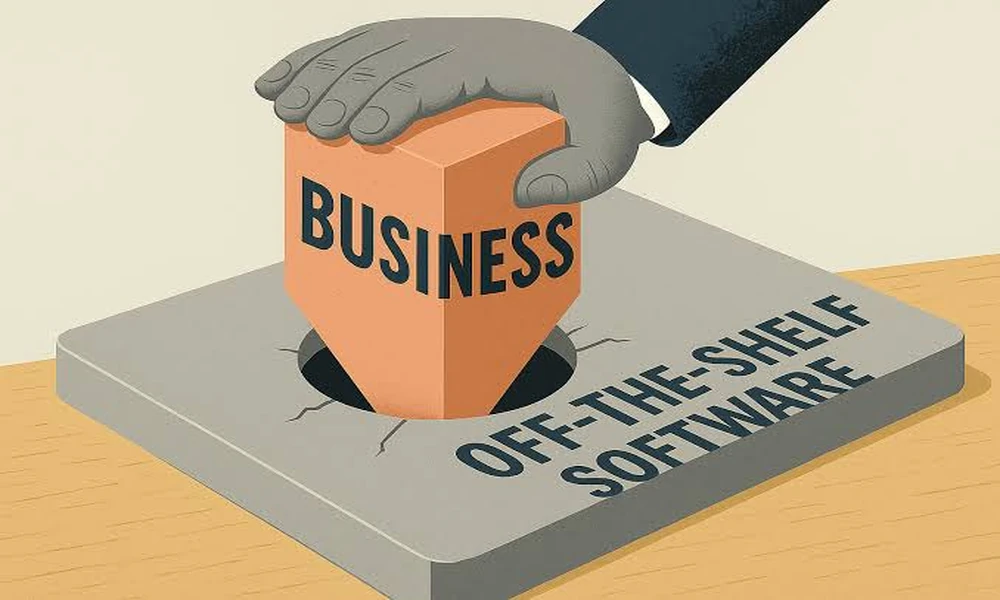
Most businesses start the same way: grab QuickBooks, sign up for a project management tool, string together a few SaaS subscriptions, and call it a tech stack. That works – right up until it doesn’t. The moment your team starts maintaining a separate spreadsheet to patch a gap in your main system, you’ve already crossed a line. You’re not using software to run your business anymore. You’re running your business around your software.
That’s the real cost nobody talks about. Not the license fees. The workarounds.
This article is a practical guide for business owners and ops leaders who sense something is off but haven’t yet named it. The goal is to help you figure out whether you have a configuration problem, a process problem, or a genuine software fit problem – and what each one actually calls for.
The Core vs. Commodity Split Every Business Needs to Make
Here’s a framework that cuts through the noise: split your operations into commodity functions and core capabilities.
Commodity functions are the things every business does the same way. Payroll. General ledger accounting. Email. Scheduling a team meeting. For these, packaged software is exactly the right answer. The problem is solved, the market has standardized it, and there’s zero competitive advantage in building your own version. QuickBooks handles your books. Gusto handles payroll. Done.
Core capabilities are different. These are the workflows, processes, or outputs that are specific to how your business competes. The way a regional HVAC company generates field bids. The way a franchise coordinates appointments across a network of technicians and home office agents. The way a specialty tech firm captures, maps, and reports sensor data from a drone in flight. No packaged app was designed for those scenarios, because the market for each one is essentially one company: yours.
Off-the-shelf software is built for reach and standardization. Custom software is built for fit and control. The mistake most growing businesses make is applying commodity logic to core capability problems – buying a generic tool and then spending years trying to bend it into shape.
“Most organizations don’t fail because they picked the wrong technology. They fail because they didn’t define success before they started building.” – Jim Johnson, co-author of the Standish Group CHAOS Report, speaking at the 2023 Project Smart conference.
That quote applies equally to the decision to buy. If you can’t define what success looks like in your specific operational context, you’ll keep buying tools that almost fit.
Five Questions That Reveal Whether You Have a Fit Problem
Before you commission anything, run your current setup through these five questions. If you answer yes to three or more, you’re dealing with a software fit problem, not a process or training problem.
- Do you maintain a separate spreadsheet to fill a gap in your main system? This is the clearest signal. Spreadsheets are not integrations. They are workarounds that grow until they become their own fragile systems.
- Does your team work across three or more disconnected apps to complete a single workflow? Context-switching and manual data transfer between apps is a hidden labor tax on every employee who touches that workflow every day.
- Does your software vendor’s roadmap control your product roadmap? If you’re waiting on a third-party feature release to deliver something your customers need, that’s a dependency problem with a business cost.
- Do new hires take longer to ramp up because of tool complexity rather than job complexity? Software should reflect your process, not add a layer of abstraction on top of it that requires its own learning curve.
- Is your data split across systems in a way that makes reporting a weekly manual exercise? Unified data shouldn’t require a Friday afternoon ritual with exports and pivot tables.
Three or more yes answers means your team is carrying an operational cost that compounds every week. The question shifts from “should we explore custom?” to “what’s it costing us to wait?”
What Good Custom Software Actually Looks Like
There’s a persistent myth that custom software means a multi-year project with an uncertain end. That’s a project management problem, not an inherent property of custom development. The research backs this up: the three major reasons a software project succeeds are user involvement, executive management support, and a clear statement of requirements , according to decades of project data compiled by the Standish Group and summarized by OpenCommons’ analysis of CHAOS Report findings. All three are things you control on the buyer side, not things a development shop controls for you.
Good custom software starts with a description phase, not a design phase. The first conversations should be about your workflow, your data, your users, and your edge cases – not about tech stacks or timelines. If a development partner skips that step and jumps straight to quoting a build, walk away.
The best results come from tight collaboration between the people who run the process and the developers building the tool. When that loop is tight, you end up with software that doesn’t just replicate your current workflow – it often reveals a better version of it.
The Local Partnership Advantage
One underrated factor in custom software success is proximity. Not just geographic proximity, though that matters, but operational proximity. A development partner who can sit down with your field techs, your back-office team, and your managers in the same room before writing a line of code produces a fundamentally different product than one working from a requirements document alone.
This is especially true for businesses with complex workflows that are hard to communicate in writing. A bid process that involves a field technician, a CRM, and a pricing model with a dozen variables is not something you can fully describe in a spec. You have to walk through it. Whiteboard it. Watch someone actually do it.
That kind of discovery work is where firms offering Custom Business Application Development in Ann Arbor, MI earn their value – not just in the code they write, but in the questions they ask before writing any of it.
The broader market for this kind of work is growing fast. Overall employment of software developers, quality assurance analysts, and testers is projected to grow 15 percent from 2024 to 2034, much faster than the average for all occupations , according to the U.S. Bureau of Labor Statistics Occupational Outlook Handbook. Competition for capable developers is real, which is exactly why a firm with an established team and proven delivery process beats building that capability in-house for most mid-size businesses.
A Quick Decision Table
| Scenario | Best Fit | Why |
|---|---|---|
| Payroll, accounting, general HR | Off-the-shelf | Standardized problem; no competitive differentiation from custom build |
| Customer-facing scheduling with franchise or field-team complexity | Custom | Workflow is unique; packaged tools require too many workarounds to scale |
| Basic CRM and email marketing | Off-the-shelf | Mature market; configuration usually handles the need |
| Field data capture that feeds proprietary reporting | Custom | Data model is specific; no packaged tool owns this workflow |
| Quality assurance tied to a proprietary manufacturing process | Custom | Core capability; process is the competitive moat |
The Timing Question
A common mistake is treating custom software as the solution you pursue after everything else has failed. By then, your team has built years of muscle memory around the workarounds, your data is scattered across four systems, and the cost of migration is real. The better trigger is earlier: when you can see that a core workflow is about to scale past what your current tools can carry.
You don’t need to be a tech company to think this way. A regional contractor, a specialty manufacturer, or a franchise operation can all have workflows that deserve purpose-built software. The question isn’t your industry. The question is whether the thing that makes your business yours is currently running on software that was designed for someone else.
If the answer is yes, that’s worth a conversation.
