

Ask ten recently married couples what they’d change about their wedding and you’ll hear ten different answers, but one theme keeps surfacing: they spent energy on the wrong things. The napkin colour got three weeks of debate. The timeline got ten minutes. Guests were left standing in the sun for an hour while the photographer finished family portraits, and nobody had thought to mention it.
Good wedding planning isn’t about doing more. It’s about knowing which decisions deserve your attention and which can be settled quickly, delegated, or dropped altogether. Here’s a practical way to think it through, whatever your budget or guest count.
Start With Three Non-Negotiables
Before comparing venues or browsing florists, sit down together and name the three things that would make the day feel right to you. Not what you think you should want, but what you’d genuinely regret skipping. For one couple it’s a long, relaxed dinner with everyone at the same table. For another it’s a live band, or having both grandmothers present, or a ceremony outdoors regardless of the weather risk.
Those three items get protected first when money or time gets tight. Everything else becomes negotiable. It sounds almost too simple, but it quietly resolves a huge share of the arguments that crop up mid-planning, because you can hold any new suggestion up against the list and see whether it belongs.
Make Room for Tradition, Your Way
Wedding customs differ enormously from one culture and family to the next, from the clothes and music to who walks whom where, how many days the celebration lasts, and what gets eaten. For a broad view of how varied these customs are, the Wikipedia page on weddings and wedding traditions around the world is a surprisingly good starting point, especially if you’re blending two backgrounds and want to understand where certain rituals come from before deciding what to keep.
The useful question isn’t “what is expected?” but “which traditions mean something to us and to the people closest to us?” Keep those, and feel free to quietly retire the ones that exist only because someone once told you they were mandatory.
Treat the Day Like the Project It Is
A wedding is, practically speaking, a one-day event with a fixed deadline, a limited budget, and dozens of moving parts that all depend on each other. That’s the textbook definition of a project, and the same habits that keep corporate events on track help here too. Our own breakdown of the event management process, from idea to execution walks through setting goals, building a schedule, assigning responsibilities, and planning for the unexpected, and almost all of it translates neatly to a wedding.
The part couples most often skip is the written run-of-day. Not a vague outline, but an actual hour-by-hour document: when hair and makeup finish, when transport leaves, when the ceremony starts, who is responsible for which task at each point. Share it with your wedding party, your vendors, and one calm friend who isn’t in the party and can step in when something slips. Something always slips.
Sorting Out What Everyone Wears
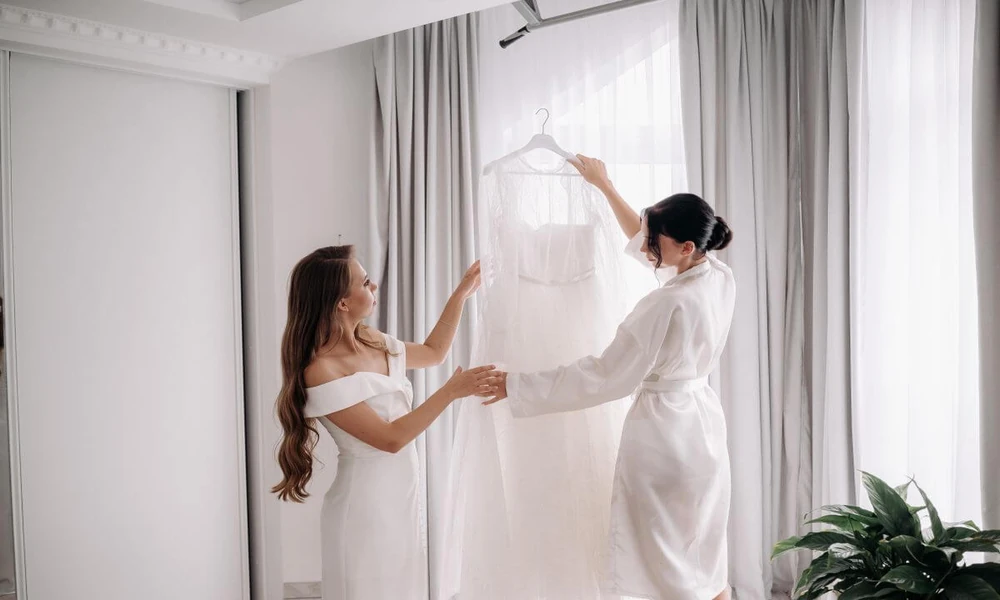
Outfits generate more stress than almost anything else, partly because so many people are involved: you, your partner, the wedding party, parents, and sometimes a long list of guests asking what the dress code means. Settle your own look early, then give everyone else clear guidance rather than leaving them to guess.
For bridesmaids, junior attendants, or younger relatives who need a formal dress without a bridal price tag, it helps to have a systematic way to choose. Prom Dress Finder‘s guide to choosing a dress is written for formal-dress shopping in general, covering how to think about fit, colour, and shape, and those principles carry over well to wedding-party outfits. If your group is scattered across different cities, agree on a colour family and a hemline length instead of insisting on one identical dress; everyone ends up comfortable and the photos still look cohesive.
Gathering Photos From Every Angle
Your photographer will capture the formal moments well. What they can’t do is be everywhere at once. The best candid shots usually come from guests: a grandfather mid-laugh at the reception, the dance floor at its most chaotic, the quiet moment before the ceremony you never knew happened. The difficulty is collecting them afterwards, since they’re spread across dozens of phones and most guests never get around to sending anything.
A shared album set up before the day solves that problem. Tools like Wedding Photo Swap let guests add pictures as they go, so you finish the weekend with one collection instead of a long trail of follow-up messages. Print a small sign with the album details for each table and mention it in the welcome speech, and participation tends to rise noticeably.
Build In Breathing Room
If there’s a single scheduling tip worth repeating, it’s this: add buffer time everywhere. Add fifteen minutes to hair and makeup, thirty to portraits, and a margin between the ceremony and the reception. Nothing about this reduces the quality of your day. It simply means that when the florist arrives late or a relative gets lost on the way, nobody has to panic.
Couples who plan this way often describe the day as calm, even when small things went wrong, because the schedule absorbed the surprises. In the end, that’s what you’re really building: a day with enough slack in it that you can actually be present for it.
